
Failure Demand: The Work That Should Never Exist
If you asked most managers where their team's capacity is going, they'd tell you: answering emails, processing requests, attending meetings, reviewing files. All of it necessary. All of it just the job.
What they rarely see is how much of that capacity is being consumed by work that only exists because something upstream failed.
This is Failure Demand — a concept coined by systems thinker John Seddon — and it is one of the most powerful lenses a Lean practitioner can apply to a government process. Lean Belt training teaches you what failure demand is and how to quantify it. Because if you can't put a number on it, you can't put a price tag on it. And without a price tag, leaders are very unlikely to act on it.
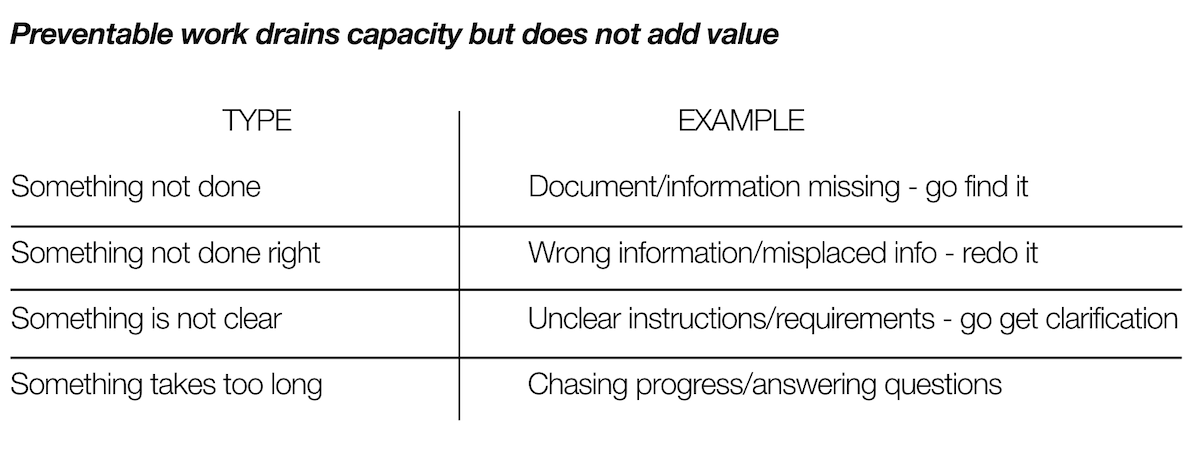
Failure demand comes in four main types. Here is each one with real public sector examples:
Work done incorrectly: Work that had to be redone because it was wrong the first time — an application processed with an error, a decision letter missing key information, a form received with the wrong data. The team corrects it, the client is frustrated, and the clock resets.
Work done not done at all: Requests or deliverables that were missed entirely, triggering a follow-up contact just to surface what should already have been done. The omission becomes a second transaction.
Unclear work: Outputs or communications that were technically completed but left the recipient confused — generating clarification emails, callback requests, and revision cycles that add zero value.
Work not done fast enough: The classic "where's my stuff?" contact. When clients or stakeholders can't see progress, they reach out. Every progress-chasing contact is a unit of demand that only exists because your process wasn't fast enough. Speeding up the process eliminates the contact — not adding a call centre to manage it.
We rarely see teams spending less than 20% of their capacity on failure demand.
In some cases, teams are spending 50%, 70%, or even 100% of their time on it — essentially becoming departments that exist solely to clean up problems created elsewhere in the system.
The math is what makes leaders sit up. If 40% of your team's time is spent on failure demand and you eliminate 75% of it, you've just freed up the equivalent of three full-time experienced employees in a team of ten — onboarded, trained, and ready. That's not headcount you have to hire. That's capacity that already exists, buried under preventable work.
Lean process improvement teaches you to identify, categorize, and measure failure demand using a structured data collection template. You'll learn to present findings in a way that lands with executives — not as a list of inefficiencies, but as a quantified cost that demands a response. And then you'll learn how to run experiments to eliminate the root causes, not just manage the symptoms. Bring the facts to your next leadership meeting and watch what happens.
LEARN MORE
Want to go further? If understanding failure demand has you wondering how much hidden, preventable work is draining your team’s capacity, the Lean Yellow Belt course is where you’ll learn to tackle it. You’ll get practical tools to spot failure demand, quantify its real impact, and trace it back to the root causes so you can eliminate it for good. To move from insight to action, explore the Yellow Belt program and start building the capability to fix the work that should never have existed.
Already have your Yellow Belt?
Copyright © 2026 Lean Agility Inc. All rights reserved. Powered by QuickSilk.