
Value Stream Mapping - Seeing the Whole Picture
Now that we've learned to define problems clearly and understand what customers truly value (Voice of the Customer), here comes the game-changer: learning to see the entire process from end to end.
Welcome to Value Stream Mapping.
The Power of Seeing the Whole
Most of us only see our piece of a process—the part that we personally touch or are responsible for. Most of us only see our leg of the relay race—the section where we carry the baton. We optimize our individual sprint without realizing the real delay happens during the handoffs, or that another runner three legs back is the actual bottleneck.
Value Stream Mapping (VSM) is the tool that lets you step back and see the entire race—from request to the delivery.
When asked to improve processes, it's tempting to start by optimizing our own piece. But that won’t work: optimizing individual steps rarely improves the overall process and even has the potential to make things worse.
Consider this real-life scenario:
In 2016, the TSA faced severe criticism for extremely long security checkpoint wait times at major U.S. airports. The response was to focus heavily on speeding up the X-ray screening process. They invested in buying faster equipment, optimizing bin management systems, and training screeners to work more quickly.
Spoiler alert: it didn't work!
The actual bottleneck wasn't the X-ray machines. A closer analysis revealed the real constraint was the divestiture area. Everyone's favourite part of the security screening where we remove shoes, belts, laptops, loose change, liquids and pocket lint. Passengers were backing up before they even reached the X-ray machines. The investment in faster screening equipment just meant cleared bins piled up faster at the other end while passengers still waited to divest.
TSA redesigned the divestiture area with more space and better bin flow, and created TSA PreCheck lanes that eliminated most divestiture steps entirely. Previously, they optimized the wrong part of the process because they didn't map the entire passenger flow.1
What Is a Value Stream?
A value stream is the sequence of all activities required to deliver a product or service to a customer—from initial request through delivery.
It includes:
- Every process step (both value-added and non-value-added [link to last article on value])
- Every handoff between people or departments, bottlenecks and delays
- Data at each step (e.g., Processing Time, Elapsed Time)
- Information flow (how work is triggered and communicated)
- Material flow (how the actual work product moves)
Value Stream Mapping is the practice of drawing out this entire sequence on paper (or digitally) to make waste visible.
The Two Maps You Need
Current State Map: What actually happens today
- Shows reality, not the ideal process documented in manuals or in internal documents
- Makes waste visible
- Reveals where value is added … and where it isn’t
Future State Map: The improved process – what should be happening
- Eliminates identified waste
- Reduces handoffs and wait times / increases flow
- Facilitates value creation based on customer need
The gap between these two maps? That's our roadmap and outlines the series of experiments that will get us from Point A to Point B
Key Elements of a Value Stream Map
 mapping the forest, not every tree.
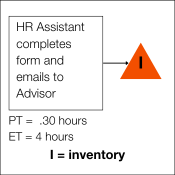
- Processing Time (PT): How long the work is actually being worked on
- Elapsed Time (ET): Total elapsed time including waiting (inbox-to-inbox time)
Often this can be eye-opening: In most processes, processing time is measured in minutes or hours, while elapsed time is measured in days or weeks.
Example: Creating a purchase order might take 30 minutes of actual work (PT = 30 min) but take 5 days to complete (ET = 5 days). Where did those 5 days go? Waiting in queues, sitting in inboxes, stuck in approval limbo.
3. Inventory Triangles: Anywhere work piles up waiting for the next step, draw a triangle. These reveal your bottlenecks.
The Value Stream Mapping Process
Where does the stream start? Where does it end? Be specific and pick a single product or service to map (don't try to map everything at once).
Step 2: Walk the Process
Don't map from your desk. Go to where the work happens and talk to the people who do it. Follow one actual job or historical file from start to finish – a reference file.
Step 3: Map What You See, Not What Should Happen
Reality can diverge from documented procedures. Map reality—that's where improvement opportunities hide.
Step 4: Calculate the Numbers
Total processing time = Sum of all PT values (actual work time)
Total elapsed time = Sum of all ET values (total elapsed time)
Process Flow Efficiency = Total PT / Total ET
Most people are surprised when they see their Process Efficiency is less than 10%. That means 90% of the time, work is just sitting there waiting.
Step 5: Identify Waste
Now that you can see the whole stream, mark where the 8 wastes occur (remember those from your White Belt? – we’ll be reviewing them next week). They'll jump off the page.
Now that you can see your whole process, we'll sharpen your ability to spot waste hiding in plain sight. The 8 Wastes aren't just theory—they're stealing time, money, and sanity from your organization every single day.
1 This illustrates the common problem of local optimization. For the theory behind system constraints, see Goldratt, Eliyahu M. The Goal: A Process of Ongoing Improvement. Great Barrington, MA: North River Press, 1984.
PRACTICE
Pick a simple process you're familiar with (could even be a personal one—like how you process your email or how your family gets their groceries). Map out the major steps. For each step, estimate: How long does the actual work take? How long does it sit waiting? Calculate your efficiency.
You might be horrified by what you discover, but that's good: now you can fix it.
Copyright © 2026 Lean Agility Inc. All rights reserved. Powered by QuickSilk.