
Building Your Team the Smart Way - First Followers and the Art of Creating a Movement
One of the most common mistakes Lean practitioners make is spending enormous energy trying to convince every skeptic in the room. They host information sessions that get ignored. They send emails that get archived. They push harder, and resistance pushes back. Sound familiar?
Here's the truth: you don't need to get everyone on the bus. You just need to find the right people first.
We teach a principle that has changed how hundreds of public servants approach change in government: the First Follower. It comes from one of the most deceptively simple videos on the internet — Derek Sivers' famous Dancing Guy on the Hill. In under three minutes, it reframes everything you think you know about leadership and creating a movement. Watch it. Seriously.
The lone dancer on the hill isn't the hero of the story. The first follower is. Because that first follower is the one who transforms a lone nut into a leader. And then the next follower feels safe joining. And then the next. Before long, it's the people not joining who look out of place.
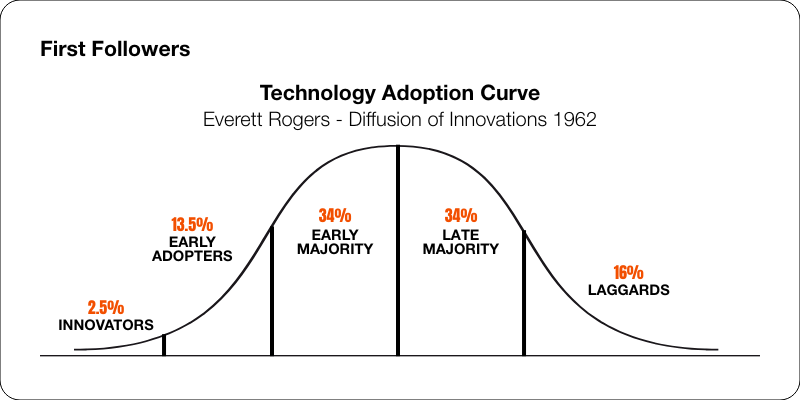
This is the Technology Adoption Curve applied to Lean projects. Every team has innovators and early adopters — the colleagues who are curious, frustrated enough to want change, and influential enough that when they join, others pay attention. These are your people. They exist in every job group, every branch, every department. The ability to identify them, bring them in early, and let them do the selling for you is crucial — because their endorsement is worth ten times yours as an outsider or project lead.
Why does this matter so much? Because the wrong approach wastes months. You chase the skeptics, try to overcome objections, schedule more meetings, and end up exhausted before the real improvement work has even started. The right approach builds momentum quietly and then suddenly — and when it tips, it tips fast.
In government, where mandated change often triggers defensiveness and where the words “Lean project” can make people reach for their resistance hat, this distinction between pushing adoption and attracting it is not a nice-to-have. It is the difference between a successful project and a shelf-ware report.
If you've ever felt like you're dragging people toward a better process while they dig their heels in, this module will change how you work. You'll leave knowing exactly who your first follower is — and how to find them in every project you run from here forward.
LEARN MORE
Productivity in government doesn’t scale through individual effort alone—it grows through the people who choose to join you. When teams try to push improvement on their own, momentum stalls. But when you identify your early adopters—the first followers who legitimize change—you transform isolated effort into collective movement.
The Lean Yellow Belt course gives gives you the tools to map your stakeholder landscape, identify your early adopters, position your project so the right people feel compelled to join, and then step back and let social proof do the heavy lifting. You learn how to “toss birds, not rocks” — creating conditions that attract participation rather than forcing compliance.
Invest in your team’s ability to create real traction: register for the Lean Yellow Belt program and learn how to build engagement, credibility, and sustainable improvement from the ground up.
Already have your Yellow Belt?
Copyright © 2026 Lean Agility Inc. All rights reserved. Powered by QuickSilk.